
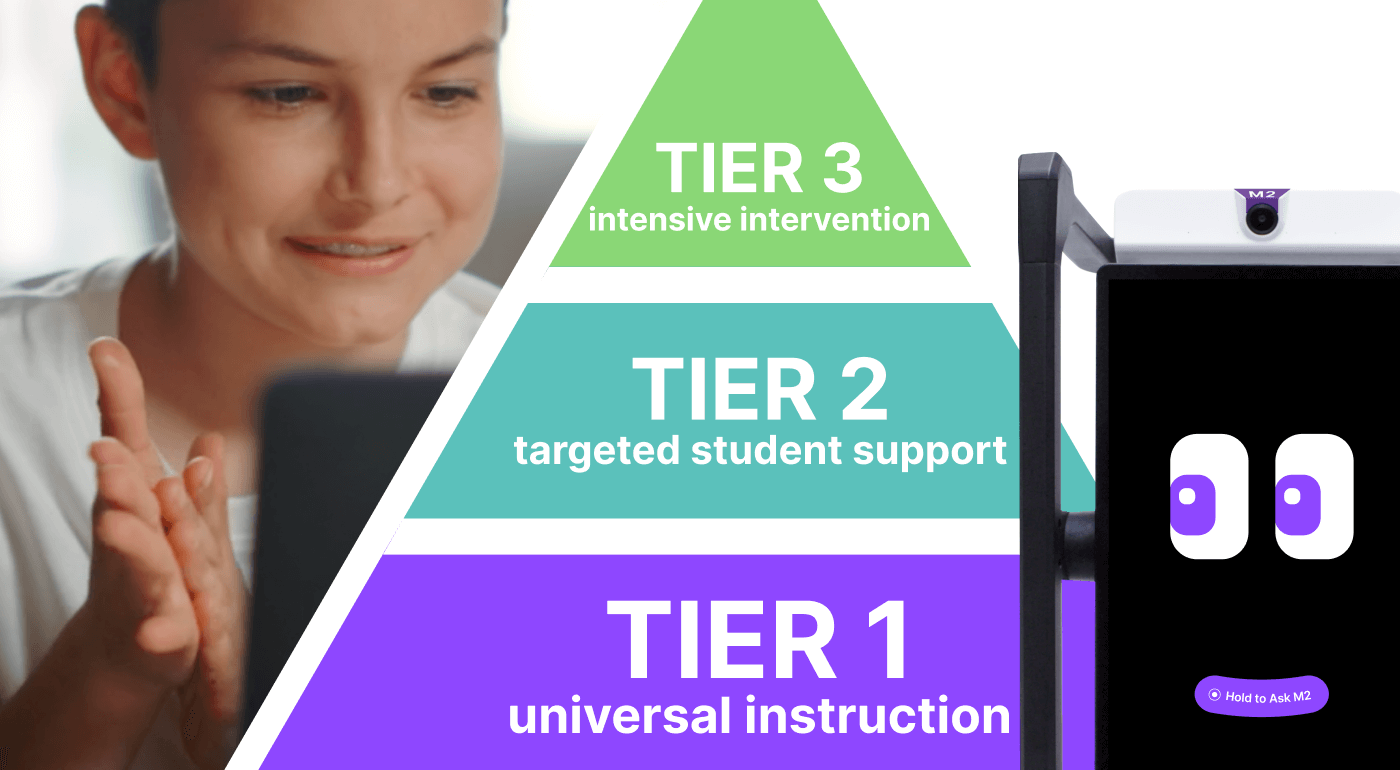
When we talk about MTSS (Multi-Tiered System of Supports), the conversation often revolves around what adults are doing—interventions, progress monitoring, and data collection. But the true measure of MTSS success is the experience of the student. Are they receiving the right support at the right time? Do they feel seen and understood?
M2 isn’t just a tool for teacher feedback; it’s a powerful, AI-driven co-teacher that works directly alongside students to support their learning journey across every tier. Here is how M2 aligns with your MTSS framework to empower learners.
Tier 1: Strengthening universal instruction with voice and agency
At the universal level, the goal is high-quality core instruction that engages all students. M2 enhances Tier 1 by acting as an always-available resource that clarifies confusion and builds metacognition without requiring immediate teacher intervention.
Building voice through reflection
- The “confessional booth” for reflection: Susan, an AP Computer Science teacher, found that M2 gave a voice to her quietest students. She described it as a “confessional booth” where students could privately reflect on their learning. This builds student agency—a core component of strong Tier 1 instruction—by allowing every child to articulate their understanding in a low-stakes environment.
- Instant clarification: We’ve all seen a lesson stall because a student missed a key instruction. With commands like “Hey M2, summarize that” or “Hey M2, what’s our objective?”, M2 keeps the entire class on track, reducing the cognitive load on the teacher and ensuring students don’t fall behind due to simple misunderstandings.
Whole Group Guides: Teaching the whole class better
Whole Group Guides take Tier 1 to the next level by ensuring every student experiences research-backed instructional strategies consistently. While M2 guides the entire class through engaging activities, teachers are freed to circulate and provide the high-leverage feedback that moves students forward.
- Research-backed strategies: Whole Group Guides use evidence-based approaches grounded in Marzano’s Nine Strategies, Hattie’s Visible Learning, and cognitive science research. Whether it’s retrieval practice to strengthen memory, dual coding to combine words and visuals, elaboration to deepen understanding, or interleaving to build flexible thinking—every activity is designed to enhance learning.
- Teacher freedom to teach: When M2 leads a Whole Group Guide, teachers aren’t managing technology—they’re teaching. They circulate the room, offer formative feedback, facilitate peer conversations, and provide instructional cues. Students get more access to their teacher, not less.
Consistent excellence: Every student in your district experiences the same high-quality instructional strategies. No more variation between classrooms in what “good Tier 1 instruction” looks like. This consistency is the foundation of true universal support.
Tier 2: Targeted support for small groups and ELLs
For students who need more targeted support, M2 acts as a force multiplier, allowing the teacher to “be in two places at once.”
The virtual teaching assistant
Kerri Bell shared how a student teacher used M2 specifically to support English Language Learners (ELLs). He placed M2 at a small group table and taught students to use the “Rephrase that” and “Translate that” functions. This provided immediate, personalized language support, allowing these students to access the curriculum independently while the teacher worked with another group.
Small Group Guides: Differentiation without stretching your team
Small Group Guides are the secret weapon for Tier 2 implementation. These flexible, student-paced activities allow teachers to deliver targeted instruction while M2 facilitates differentiated learning for specific groups.
- Flexible, zero-prep options: Teachers can pre-plan detailed Small Group Guides for predictable intervention needs (struggling readers, math fact fluency, language development) or launch zero-prep activities on the fly when a teachable moment arises. A small group needs extra practice with fractions? A cluster of ELL students needs targeted language support? A group of advanced learners needs an enrichment challenge? Teachers tell M2 their objective and launch an activity instantly.
- Student-paced progress: Unlike whole-group activities, Small Group Guides let students progress at their own pace. Each student’s answers are captured and scored, giving teachers concrete data on what they’ve mastered and where they’re still struggling—critical information for Tier 2 decision-making.
- Teacher flexibility: While M2 facilitates one small group, teachers work with other students. They might provide intensive one-on-one support to a struggling reader, monitor multiple learning stations, or coach a group through a complex project. Your limited Tier 2 interventionist time goes further because it’s strategically deployed where it’s most needed.
Facilitating group work
Dr. Darcel Hogans discovered that her students loved collaborative work when “M2 is watching.” The presence of the device didn’t just monitor them; it engaged them. Students actively asked M2 questions during research—like science students who used M2 to dive deep into topics like the tongara frog. M2 becomes a station facilitator, guiding group inquiry and ensuring that “independent work” is truly productive.
Tier 3: Intensive, personalized scaffolding
At the most intensive level, students often need significant scaffolding and immediate feedback. M2 provides a non-judgmental space for students to struggle, fail, and try again.
Scaffolding complex thinking
M2 doesn’t just give answers; it prompts thinking. When a first-grader in Megan Rozzana’s district was learning about stars, M2’s feedback helped her make a complex connection between the Big Dipper and navigation—a “lightbulb moment” that might have been missed in a busy classroom. For Tier 3 students, this immediate validation of their thinking is crucial for building confidence and persistence.
Differentiation on-demand
With Guides, M2 can create standards-aligned small-group or individual activities connected to the day’s lesson. Each Guide is centered around a research-backed instructional strategy from Marzano, Hattie, Lemov, and other instructional experts. Guides can provide extra support when intervention needs arise quickly, or free up teachers for one-on-one intensive support while other students work with M2.
Assessing understanding automatically
After the day’s lesson, M2 can help teachers understand where their Tier 3 students have knowledge gaps and where they’re making gains. M2 can generate Assessments, score them automatically, and provide feedback to both the teacher and the student. Because M2’s questions are adaptive and voice-based, responses are authentic windows into student understanding—not surface-level answers to traditional multiple choice questions.
This real-time insight helps teachers know: Is this student ready to step down to Tier 2? Do they need a different intervention strategy? Are they ready to return to Tier 1? These decisions are no longer based on gut feeling; they’re based on data.
The student-centered MTSS
By integrating M2 into your MTSS framework, you aren’t just collecting data on students; you are providing support for them.
Whether it’s:
- A shy student finding their voice in a private reflection (Tier 1)
- An ELL student getting instant translation and support in a small group (Tier 2)
- A struggling learner getting immediate, non-judgmental scaffolding and feedback (Tier 3)