
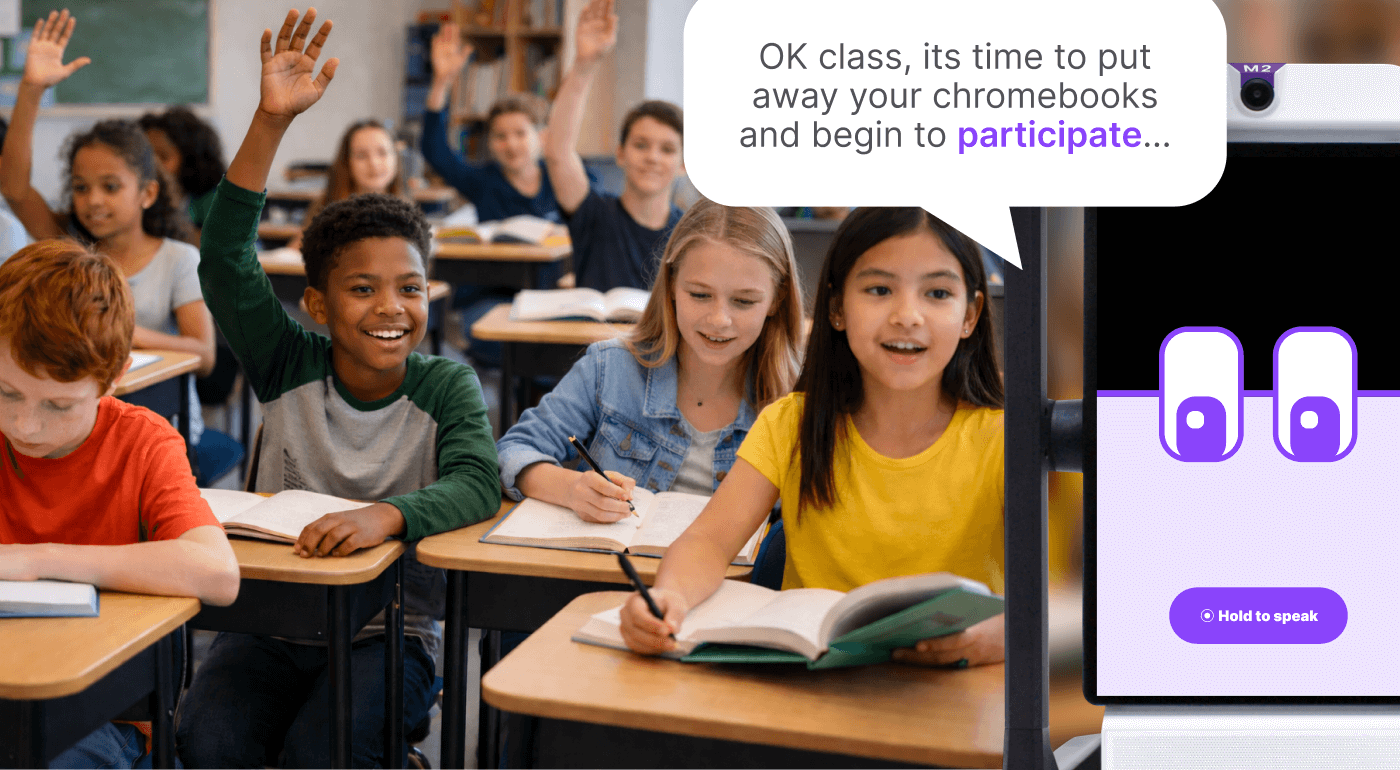
The M2 score measures participation as the foundational condition for learning.
It captures whether a classroom consistently creates, sustains, and distributes opportunities for thinking—moment by moment, across an entire lesson.
Participation is not a side effect of good instruction. It is the primary result of good instruction. When participation is strong, curricula come alive for teachers and students. When participation is weak, even the best materials fall flat. M2 exists to make that invisible truth measurable.
Why participation and not engagement?
Engagement in learning matters, but not all of it is objectively observable. Participation is the observable layer of engagement. It is behavioral and concrete, spans many dimensions—speaking, writing, questioning, persisting, building—and, we believe, can become a durable capability students carry beyond any lesson into the real world.
That’s why we focus on participation.
Why Participation Is What Makes the Difference
Participation is the engine of effective instruction. It’s what separates strong teaching from exceptional teaching and determines whether curriculum is truly being implemented or merely covered.
Instructional frameworks like Danielson, Marzano, and Teach Like a Champion all recognize this. They emphasize participation through domains, components, and moves. But their complexity makes participation hard to see clearly and even harder to act on consistently.
M2 cuts through that complexity with simplicity and focus, and treats participation as the single, fundamental indicator of instructional success.
By making participation measurable, M2 gives teachers clear goals and actionable feedback, turning improvement into something practical, repeatable, and achievable every day. feedback, turning improvement into something practical, repeatable, and achievable every day.
What the M2 score measures (at a high level)
M2 does not measure student learning after the fact. It measures how classrooms make learning possible.
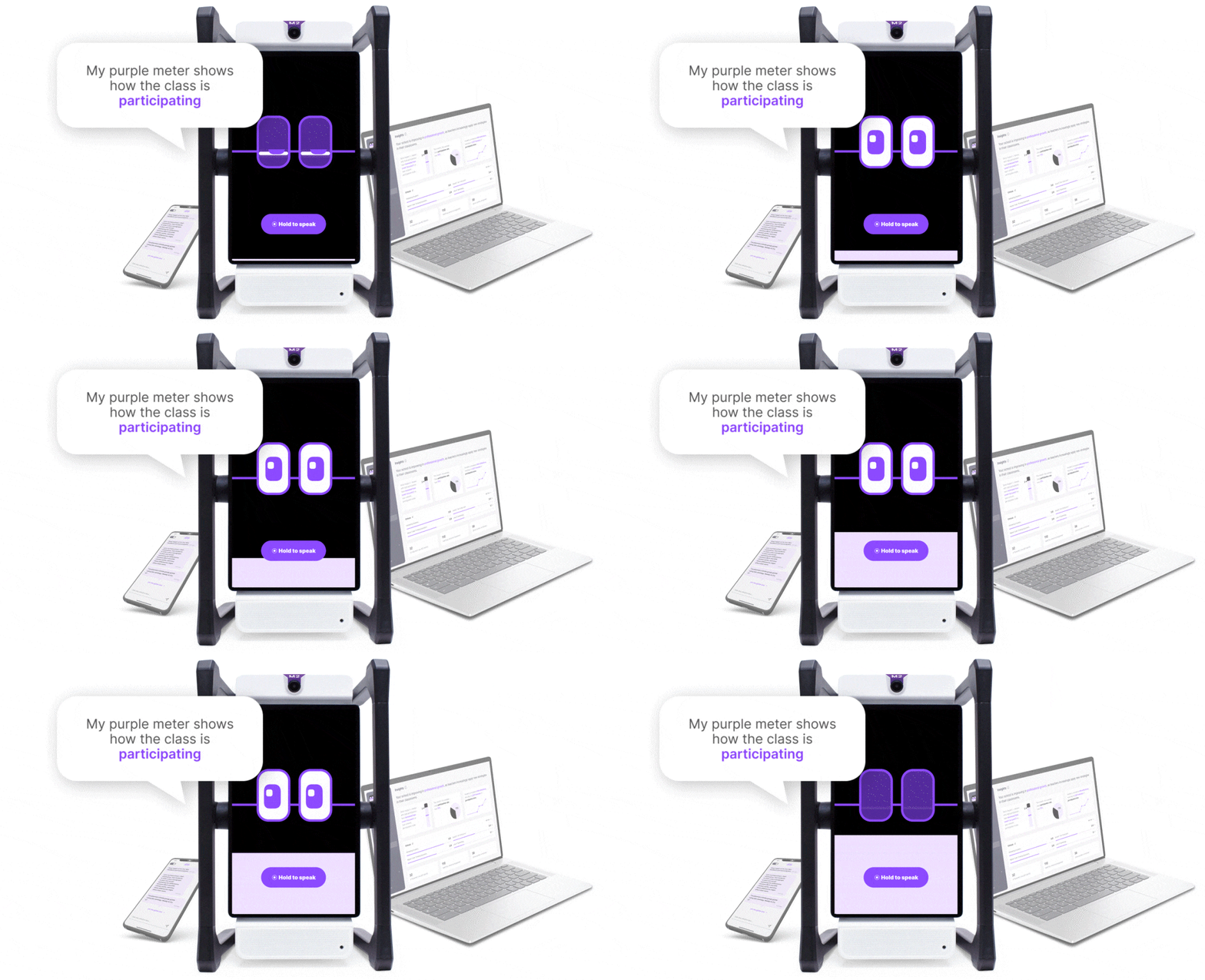
Specifically, the M2 score captures participation as a collective, time-based property of instruction: how thinking emerges, spreads, deepens, and recovers throughout a lesson. These patterns reveal the conditions the teacher has created for student learning.
Across thousands of classrooms, M2 organizes participation into three essential attributes:
- Participation is made possible
- Participation is sustained
- Participation is distributed
Each attribute shows up through observable instructional signals. M2 detects and interprets these signals during class, displaying participation status in real time. When the meter is above the line, it indicates that everyone is on task and that opportunities to share and participate are being created and sustained.
How M2 makes participation possible
Participation must be possible before it can happen, and teachers create those conditions.
M2 looks for whether the teacher invites thinking through:
- Clear routines and norms for participating
- Questions and tasks aligned to the learning objective
- Structures that allow students’ voices and ideas to surface (whole group discussion, small group collaboration, focused independent work)
Whenever students are applying their minds toward a learning activity, whether that’s speaking, writing, problem-solving, or reading, they are participating. M2 captures whether instruction consistently opens the door for that to occur.
How M2 measures sustained participation
Participation that flickers but then dims doesn’t lead to learning. It has to persist for the whole class.
M2 measures whether participation holds across time by observing:
- Dwell time after questions: How long does the teacher allow students to sit with uncertainty? Is silence tolerated? Does thinking have time to emerge?
- Return to ideas: Do students and teachers revisit and build upon earlier ideas, or does the lesson reset every minute?
- Recovery after struggle: When the class gets stuck, do they give up or persist with teacher support?
These signals show whether participation is brittle or resilient, shallow or cumulative.
How M2 measures distributed participation
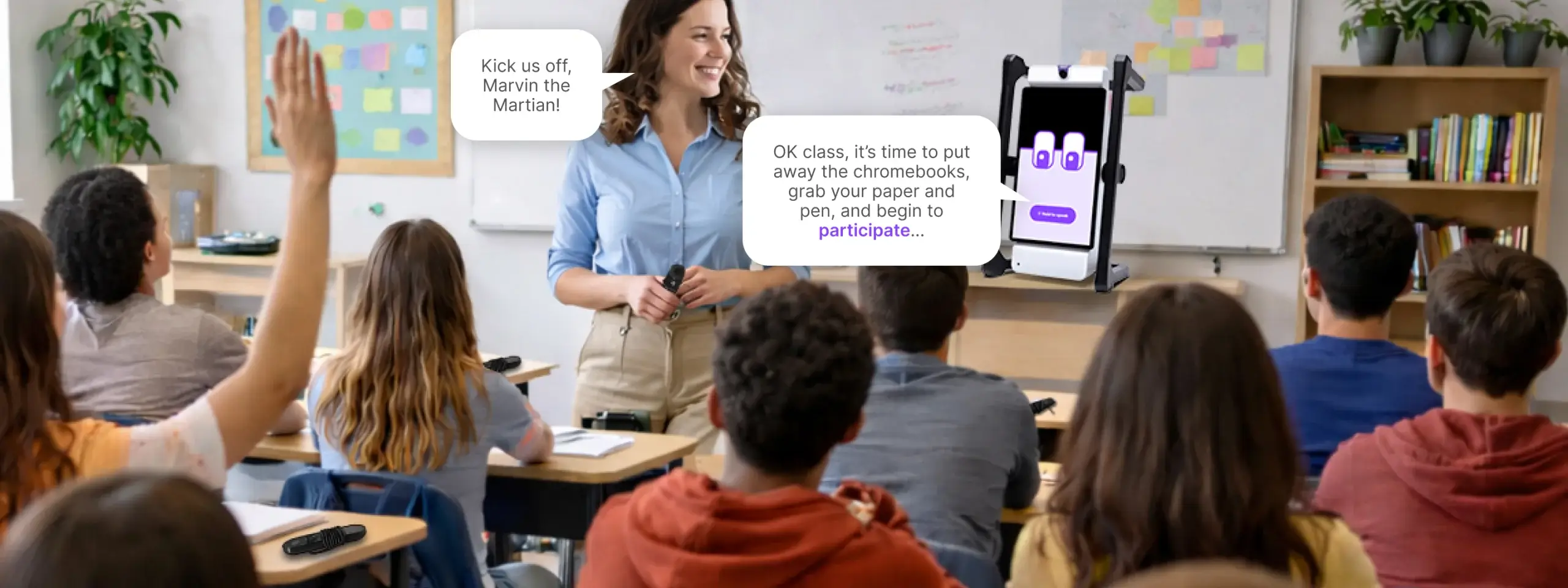
Learning improves when thinking is distributed across the class. When students expect the same few classmates to answer every question, the learning stops with those few kids. M2 helps ensure everyone is involved in the cognitive participation required to move the lesson forward.
M2 looks at the distribution of participation over time:
- Is thinking concentrated with the same few student voices all class, or does it broaden to include everyone?
- Does the teacher work to bring new contributors into the discussion as the lesson progresses?
M2 does not track who spoke, how often, or how loudly. It observes whether the lesson structure invites many minds into the work.
Distributed participation also shows up during:
- Transitions between modes: Some students succeed in whole-class settings, while others thrive in a pair activity. Certain kids thrive when giving factual explanations while others jump in to offer synthesis.
- Moments of social learning: Is the room focused on a common idea, or fragmented across individual tasks and distractions?
These are fragile moments where participation often collapses, and where strong instruction keeps it alive.

What the M2 score does not measure
To stay meaningful, M2 is intentionally limited. It does not measure:
- Individual student behavior
- Who spoke how much
- Compliance proxies (posture, eye contact, stillness, hand-raising frequency)
- Emotional states, moods, or affect
- Permanent student records, rankings, or behavior histories
Feelings fluctuate, and behavior can vary day to day, but participation persists in a classroom focused on learning. As a result, M2 provides insight without surveillance and feedback without labeling.
The M2 Participation Rubric
Our work as the creators of M2 involves distilling the philosophy laid out above into a repeatable rubric that can be used to measure and report on instruction in a variety of teaching and learning contexts. When a teacher begins a new class with M2, we use this rubric to measure the participation occurring:
- 1: Minimal student voice; mostly teacher talk; few or no student responses.
- 2: Some participation but uneven; short or prompted responses; limited peer-to-peer.
- 3: Many students contribute; responses show thinking; teacher facilitates distribution.
- 4: Broad, sustained participation; students build on ideas; evidence of collaboration and ownership.
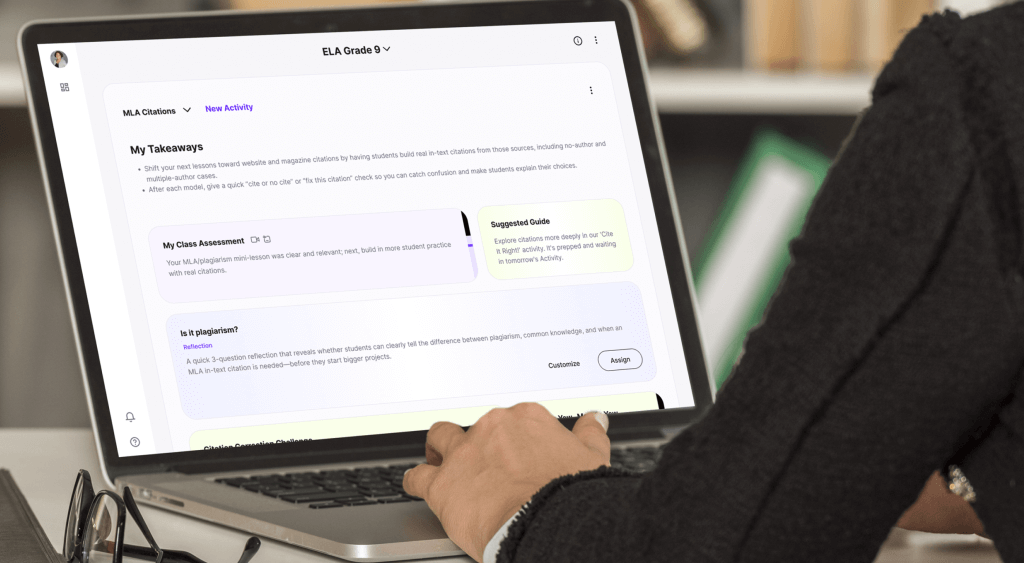
This rubric powers the real-time participation meter and post-class scoring and feedback. Together, these give teachers a granular yet actionable measure of how they are helping to create, sustain, and distribute opportunities for participation in their classroom.
Why the M2 score matters
The M2 score makes participation visible without turning classrooms into compliance systems. It gives teachers feedback they can act on immediately. It reframes instructional improvement as something grounded in daily practice, not abstract evaluation.
When the class centers on frequent, shared, quality participation, a shared goal emerges, and student and teacher incentives align. Students transform from passive consumers of information to active cognitive participators in their own learning. The teachers mindset shifts from covering curricular to creating the conditions for deep understanding to emerge.
M2 measures those conditions, so great teaching can be built deliberately, not left to chance.