
What is MTSS? Why do districts struggle with it?
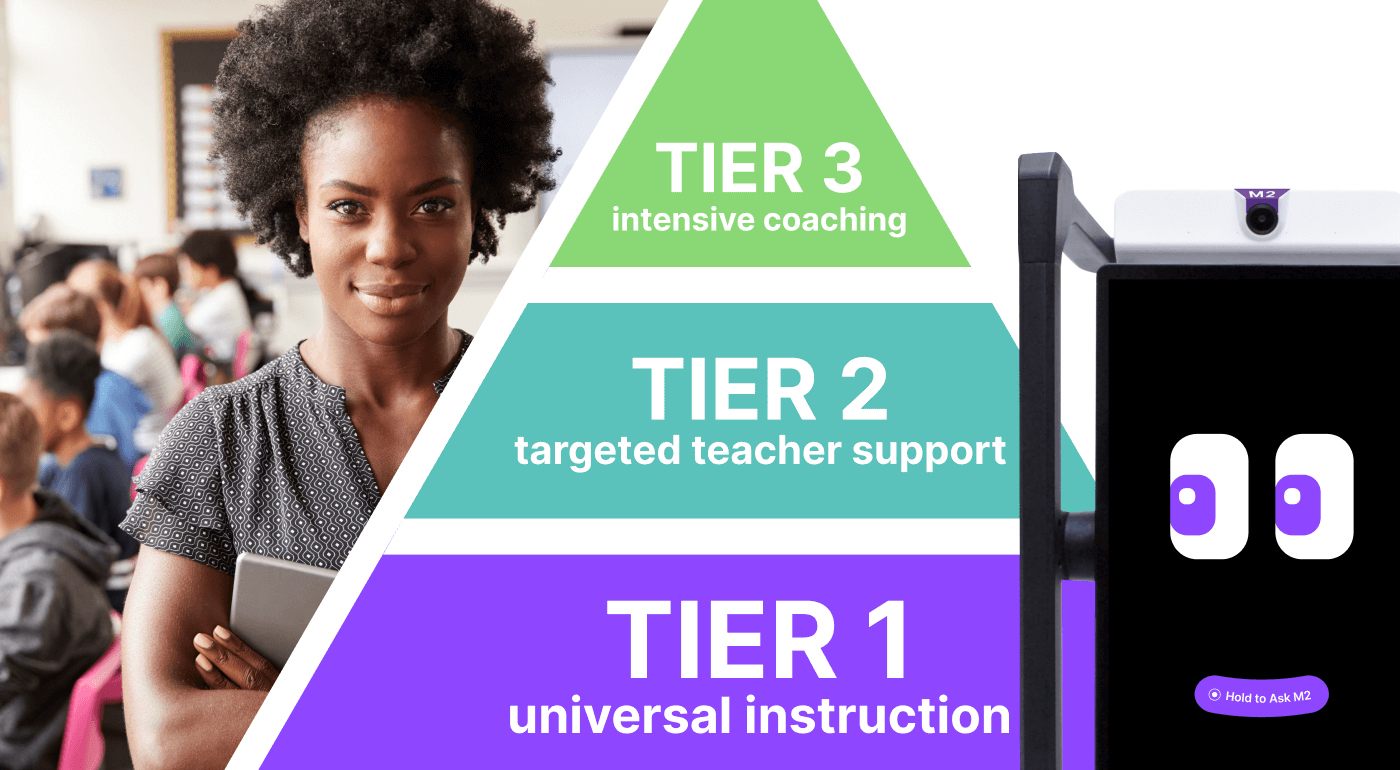
Multi-Tiered Systems of Support (MTSS) is designed to be elegant in theory: a three-tier pyramid where Tier 1 provides strong universal instruction for all students, Tier 2 offers targeted interventions for students who need extra support, and Tier 3 delivers intensive, specialized services for those with the greatest needs.
But elegant theory doesn’t always translate to classroom reality.
Districts across the country have invested in MTSS frameworks. They’ve trained their staff, bought intervention materials, and hired interventionists. Yet many report the same frustration: inconsistent implementation across schools, staff stretched too thin to provide quality support, and data scattered across multiple systems—making it hard to know if the system is actually working.
The problem isn’t the framework itself. The problem is the logistics of making it work at scale.
Now, with M2, that’s changing.
The three barriers to MTSS success and the M2 solution
Multi-Tiered Systems of Support (MTSS) is designed to be elegant in theory: a three-tier pyramid where Tier 1 provides strong universal instruction for all students, Tier 2 offers targeted interventions for students who need extra support, and Tier 3 delivers intensive, specialized services for those with the greatest needs.
Barrier 1: Fidelity – The consistency challenge
You can’t improve what you can’t measure, and you can’t measure what isn’t consistent. A major implementation concern for many districts is the lack of uniformity in how MTSS is actually practiced.
What “Tier 1 instruction” looks like at Elementary School A might be completely different from Elementary School B. One teacher is checking for understanding every five minutes; another assumes all students are keeping up. One school has clear classroom routines; another is constantly managing behavior. This drift in practice means that students don’t experience consistent support—and your MTSS framework becomes more of an idea than a system.
How M2 solves it:
M2 standardizes the feedback loop by allowing you to upload your specific district frameworks—whether it’s Danielson, Marzano, or your own custom “Great Teaching” rubric—directly into the M2 Admin Dashboard. Now, every piece of feedback a teacher receives is aligned to your standards and your vision of excellent instruction.
When a teacher at School A and a teacher at School B both use M2, they’re not just getting generic coaching. They’re receiving feedback grounded in the same language, the same expectations, and the same district priorities. It’s not about robotically enforcing rules; it’s about creating a shared language of excellence. That consistency is the foundation of true MTSS fidelity.
Barrier 2: Capacity – The staffing and burnout crisis
Most districts have robust MTSS plans on paper. But executing them? That requires people—coaches, interventionists, specialists, and leaders who can observe, analyze, and support every teacher in the system.
In reality, instructional coaches are stretched impossibly thin. A coach might be responsible for 20, 30, or even 50 teachers. That means classroom observations happen once or twice a semester. Teachers get feedback weeks after a lesson. Critical gaps in professional development go unaddressed. And staff burnout skyrockets because educators feel unsupported and isolated.
This capacity crisis creates a vicious cycle: without consistent feedback, teachers don’t improve. Without teacher improvement, students don’t thrive. And Tier 2 and Tier 3 interventionists find themselves overwhelmed because Tier 1 instruction wasn’t strong enough in the first place.
How M2 solves it:
M2 acts as a force multiplier. By giving every teacher a private, AI-powered co-teacher that delivers immediate, non-evaluative feedback, you’re effectively extending your coaching team’s reach exponentially.
Consider what happened at Newnan High School in Georgia. Their instructional coaches found that M2 transformed their work. One coach said, “It’s almost like it clones me. I’m able to be in more places at once.” Instead of spending hours on observation logistics and writing notes, coaches could focus their expertise where it was most needed—on Tier 2 and Tier 3 support, knowing that Tier 1 instruction was being strengthened daily for every teacher.
Teachers also reported that M2 felt less threatening than a formal observation. It was private, focused on growth rather than evaluation, and available 24/7. This creates a culture of continuous improvement instead of occasional judgment—exactly what sustainable MTSS requires.
Barrier 3: Data – Moving from guesswork to action
MTSS is supposed to be data-driven. But for many districts, the data doesn’t actually drive anything.
Progress monitoring data is scattered across multiple platforms. Some metrics are subjective (notes from walkthroughs). Others arrive too late to matter (semester grades, end-of-year test scores). And collecting it all is incredibly labor-intensive, pulling teachers and coaches away from the work that actually moves the needle.
As a result, leaders make decisions based on incomplete information. They can’t pinpoint where professional development dollars should go. They miss the bright spots of excellence that should be celebrated and scaled. They can’t objectively measure whether their “checking for understanding” initiative is actually happening in classrooms—or if it’s slipping because teachers revert to old habits under stress.
How M2 solves it:
M2 provides objective, real-time data on what’s actually happening in classrooms. It captures engagement patterns, questioning depth, instructional pacing, and student talk time—without bias or subjectivity.
For district leaders, the dashboard offers a bird’s-eye view of these trends across all classrooms. You can see, objectively, whether the practices you’re prioritizing in professional development are taking root. You can track progress over time and identify which schools need more support. You can celebrate the teachers who are crushing it and learn from them.
This turns data monitoring from a compliance burden into a strategic asset. You know exactly where your resources should go. You have proof of what’s working. And you can adjust your MTSS approach in real time, not months later.
From framework to reality
Implementing MTSS with genuine fidelity is heavy lifting. It requires consistency, capacity, and clear data—three things that have historically been hard to achieve at scale.
But M2 changes what’s possible.
By ensuring every teacher receives feedback aligned to your district’s standards, by extending your coaching capacity without burning out your staff, and by providing objective data that informs every decision, M2 bridges the gap between the elegant MTSS framework on paper and the real, thriving support system that students and teachers actually experience.
That’s not just better MTSS. That’s MTSS that works.