
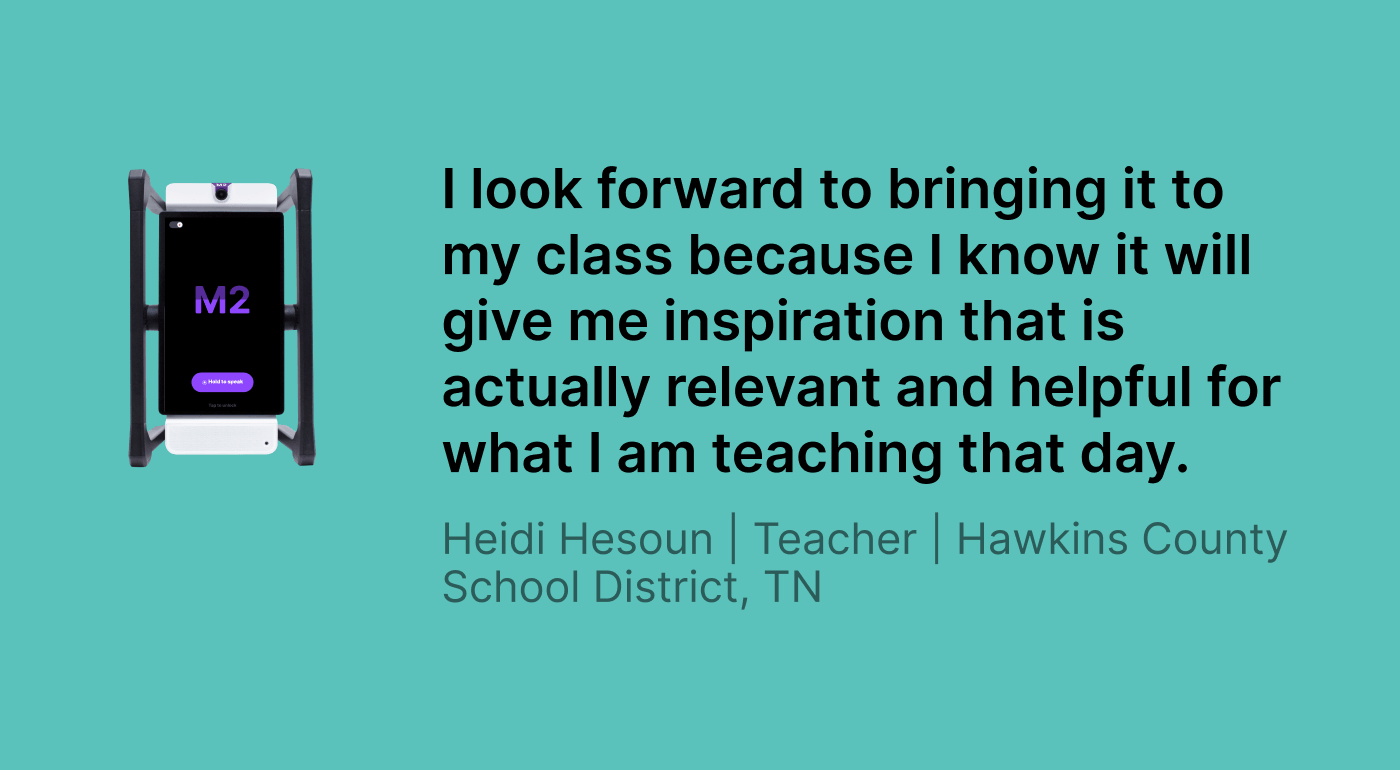
I gave it a chance and I immediately found value in its feedback and instructional ideas. In fact, I look forward to bringing it to my class because I know it will give me inspiration that is actually relevant and helpful for what I am teaching that day.
Heidi Hesoun | Teacher | Hawkins County School District, TN
USE CASE
Supporting new teachers, leveraging AI for real-time feedback
Organization
Hawkins County School District, TN
Grade Level
Middle School
What does a coaching model look like when you have five middle schools, a limited budget, high teacher turnover, and academic coaches and school administrators who can’t be everywhere at once?
For Dr. Loralee Price, Instructional Technology and Data Integration Supervisor for Hawkins County School District in rural East Tennessee, finding the answer to this question was the district’s daily struggle.
Like many districts, Hawkins County has dedicated academic coaches and administrators who care deeply about teacher growth. But care and capacity are two concepts that sometimes fail to become compatible. Coaches split across schools could observe a teacher once or twice a month. Administrators walk through classrooms weekly. But by the time a meaningful debrief occurs, that lesson might be a distant memory.
The district needed something that could close that gap: feedback that was immediate, specific, and available in every classroom, not just those a coach or administrator was able to visit.
The other challenge is one that many districts in the region are experiencing: constant turnover. A wave of newer educators has flocked to Hawkins County’s middle schools in recent years, many with limited classroom experience. For those teachers, the traditional model of professional development: periodic observations, scheduled debriefs, formal evaluations, rinse/repeat, can feel like too little, arriving too late.
Budget constraints compounded the issue. Hawkins County is a small, rural district where, as Dr. Price puts it, “funding is scarce.” Expanding professional development in any meaningful way meant finding a solution that could scale across five schools without requiring a proportional increase in cost or staffing.
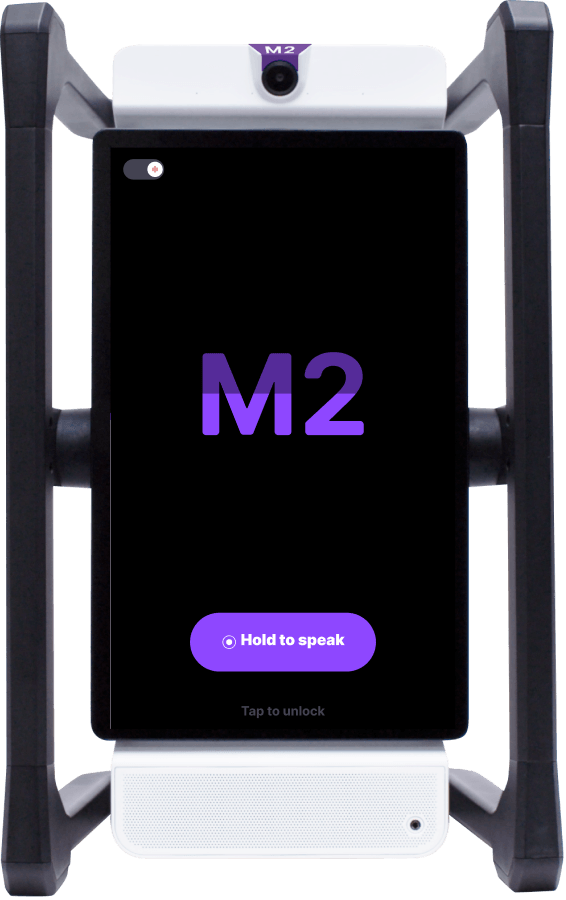
When the district learned about M2, they scraped together what limited budget they could to invest in hardware. And upon learning about Swivl’s AI Innovation Grant in 2025, they applied for and won the remainder that they needed to realize their first full pilot year. With the assistance of grant funds, they were able to ensure that every middle school, every core and special education teacher, every coach and administrator, in the program from day one could be supported by M2. Here’s what they accomplished in that first year.
Noticing the unnoticed
The first thing teachers noticed was that M2 was paying attention to things that no one else was able to spend enough time to notice themselves.
Sydney Allen, from Church Hill Middle School, moved to the far side of her classroom mid-lesson to check in quietly with a student who was struggling with material. It was the kind of moment that is often missed: too small for a formal observation, too easy to forget by the time a coach arrives. M2 picked up the conversation, provided some concrete next steps for the teacher in her post-session feedback, and bam! A situation that could have led to a student falling through the cracks was rescued by M2’s reminder.
Wesley Thomas, of Rogersville Middle School, discovered something he hadn’t known about himself. “After reflecting on a lesson with M2 advised I use a timer for certain portions of class. I don’t think I would have realized this on my own.” A pacing problem, invisible to him, made visible by a single reflection with M2.
Shawn Swickheimer, in his second year at Church Hill Middle, found a different kind of value. By comparing lesson summaries and takeaways across class periods, he could see which class hadn’t fully grasped the material and adjust before teaching it again the next day.
Elizabeth Saxena at Church Hill Middle used M2 during a formal evaluation. M2’s scoring aligned closely with the formal evaluator’s score. For teachers like her who can feel anxious about formal observations, that reassurance can make all the difference to preparing for the real thing.
M2 in the classroom: Real examples
The impact wasn’t limited to teacher growth. In Jeffrey Klepper’s ELA classroom at Surgoinsville Middle School, students used Ask M2 to strengthen how they cited evidence from texts — a literacy skill that Klepper was actively building, with M2 reinforcing it in the moment students needed it.
In Hannah Price’s science class at Church Hill Middle, students weren’t waiting to be called on. They were asking M2 questions on their own, driven by curiosity that the lesson had sparked.
At Clinch School, Jessica Drinnon’s ELA students worked through small group discussions with M2 providing support alongside them.
Skepticism turned into a superpower
Before any of these gains could be realized, teachers had to trust the tool. That’s rarely a given, especially with technology that assesses instruction.
Heidi Hesoun at Surgoinsville Middle School was one such teacher whose trust M2 needed to earn. “When our district team introduced M2, I initially had a lot of reservations, but I gave it a chance, and I immediately found value in its feedback and instructional ideas. In fact, I look forward to bringing it to my class because I know it will give me inspiration that is actually relevant and helpful for what I am teaching that day. The best part is the instant feedback I can get after every lesson. I don’t have to wait to schedule a meeting for someone to observe me, it’s my own little ‘coach.’”
Heidi’s principal, Karen Bear, also noted the initial hesitation around the school. “Teachers in my building were initially skeptical due to various concerns about who might see the lesson; however, through consistent use and an understanding that all of their lesson data would remain private, they have come to embrace it as an everyday tool that enhances their instructional practice.”
Many teachers felt like Heidi at first, so during one of the district’s onsite trainings, Swivl’s professional development team ran an exercise called “What M2 is NOT Saying.” The goal: help teachers understand how to read M2’s feedback without getting stuck on the details and inevitably spiraling. For example, feedback from M2 that surfaces a pattern in someone’s pacing or questioning isn’t a verdict. It’s simply a data point to grow from. And the point was driven home: your lesson – your data – your privacy. You choose what and when to share. The exercise reframed what M2 observed from something evaluative into something useful.By the end of this crucial session, every teacher had created a personal goal tied to their own data and a concrete coaching plan for acting on it. The room that had walked in with questions walked out with direction.
What’s next for Hawkins
Dr. Price can attest that “by piloting this technology in our middle schools, we’ve moved from a model of occasional observations to a culture of continuous reflection and improvement.” Her vision for M2 extends beyond just a middle school pilot.
What she has found most encouraging is how the ‘privacy-first’ design of M2 shifted teacher mindset from evaluation to empowerment. Dr. Price notes “our novice teachers, in particular, are using this non-biased feedback to master instructional skills in a low-stakes environment. As we look toward scaling—even amidst budget constraints—we are prioritizing our early-career educators. We aren’t just giving them a tool; we are giving them the autonomy to own their professional growth.”
For any district, rural or otherwise, where budget constraints are constant and capacity is finite, the value of a tool that’s present in every classroom cannot be understated. Catching the quiet conversation in the corner, surfacing a pacing problem the teacher didn’t know they had, helping someone see what’s working and what isn’t before another week passes. Without a constant companion to help teachers grow, these issues pile up, feedback falls through the cracks, and students ultimately suffer.