
If you’ve been through the National Board process, or supported someone who has, you know the scope of the commitment. It’s an exhausting, rewarding marathon of recording lessons, rewatching them, and trying to self-assess against demanding rubric criteria.
For many teachers, the hardest part is the isolation. With Swivl’s M2, candidates gain a comprehensive preparation system that supports them through the messy middle of the process, building the awareness and skills needed to produce a high-scoring portfolio.
Phase 1: Building awareness through structured feedback
National Board commentaries ask candidates to narrate specific instructional decisions. Reconstructing these decisions from memory is a challenge, especially if a teacher is reflecting days or weeks after a lesson.
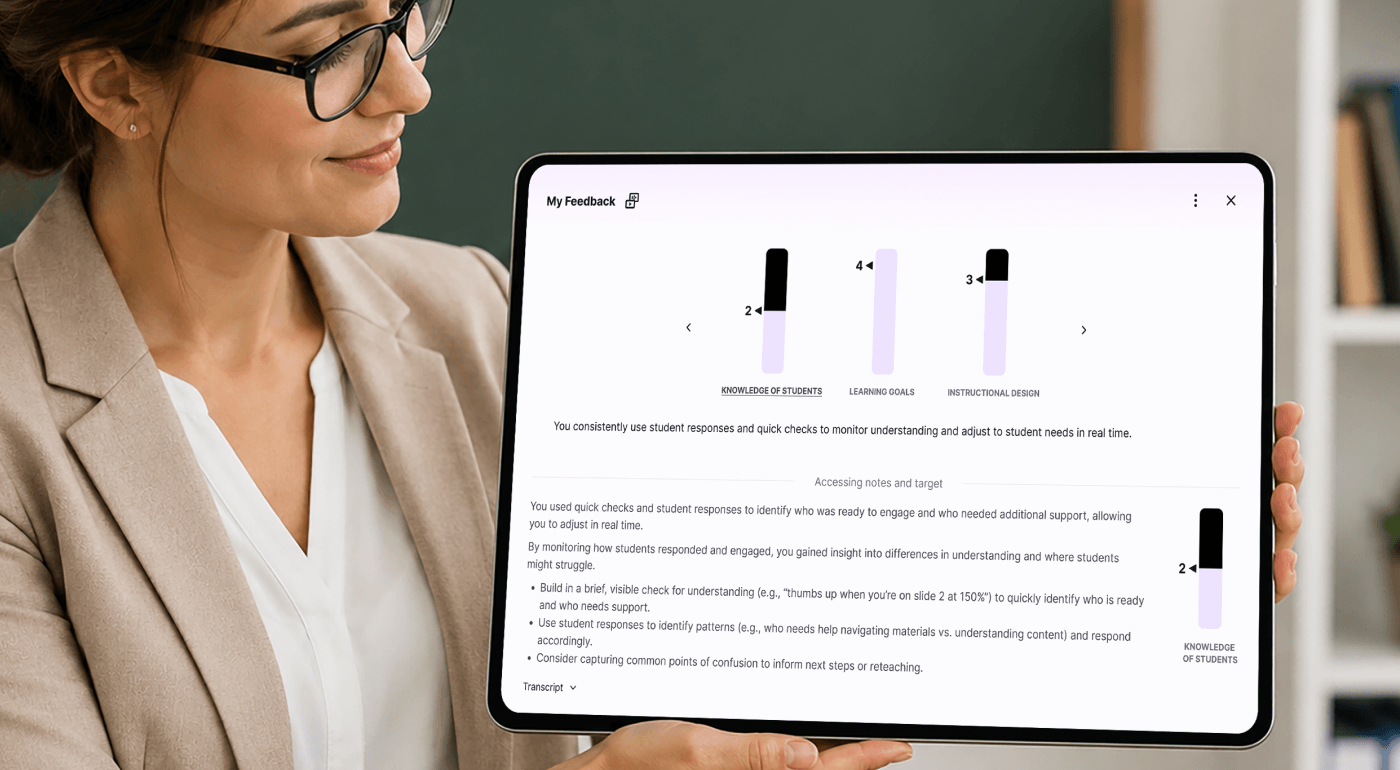
M2’s My Feedback breaks practice sessions into segments (opener, direct instruction, guided practice, etc.), providing a well-organized map of the lesson. This helps candidates pinpoint exactly when instructional goals were met or missed.
By providing far more structured feedback than teachers would typically get during a school year, M2 helps National Board candidates build their skill of metacognitive reflection, which transfers directly to their submission work.
Phase 2: Targeted self-assessment
The National Board is not only about good teaching; it is also about meeting specific, rigorous standards.
Using the Rubric Builder, candidates or coaches can create criteria modeled directly on National Board standards, such as differentiation or student engagement. Then, a teacher simply turns on M2 at the beginning of any class, and they’ll receive a detailed feedback report based on the National Board rubric criteria.
By self-assessing their practice and making instructional adjustments, candidates can see their scores trend upward over time. When candidates are then ready to record and submit their final submissions, they come to that experience with a sense of confidence built over weeks or months of deliberate practice.
Phase 3: Internalizing the reflective cycle
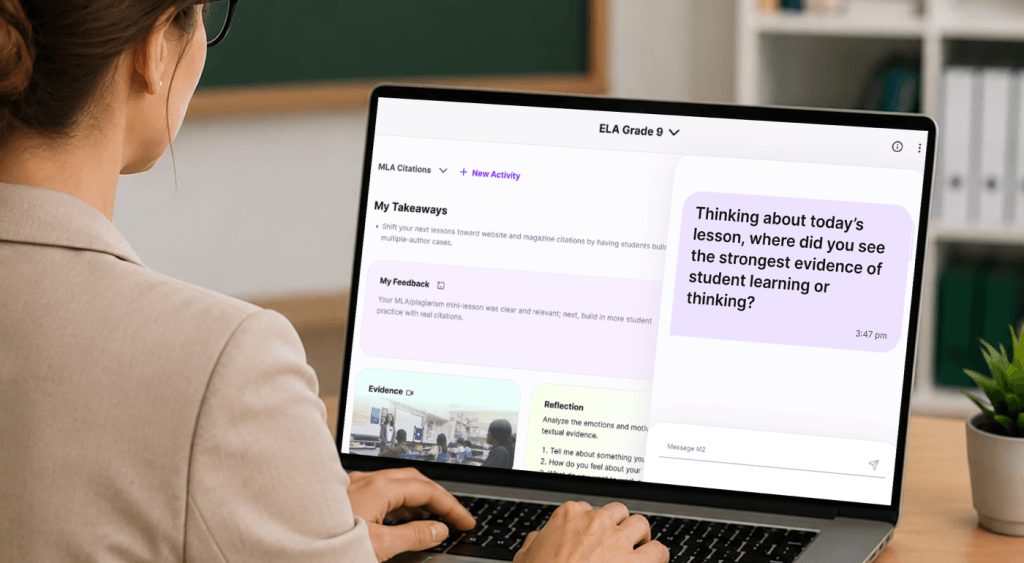
Reflective practice is the through-line of the entire National Board process. Chat with M2 offers a coaching-style conversation after practice sessions, drawing on transcripts to help candidates talk through their reasoning: Why did I shift strategies there? How would I justify this to an assessor?
M2 provides a unique opportunity for a teacher to have a detailed, evidence-based conversation with a voice that has knowledge of the lesson that was just taught. Furthermore, a teacher can have this experience every day, or even multiple times a day, when they are working with M2.
In early practice sessions, Live Tips act as a digital coach, offering classroom management tips, check-for-understanding suggestions and discussion questions in real-time.
Mid-lesson, a teacher can request a tip from M2, which is tailored to the precise context of the class being taught. The teacher can then implement this adjustment to their lesson and monitor the results. This builds the “muscle memory” for the reflect-adjust-teach loop required by the Board. By the time a candidate is ready for their final submission, these high-impact moves have become second nature.
Phase 4: The final submission
When a candidate has built the confidence and metacognitive skills to meet the standards, the M2 hardware transitions from a coach to a professional recording suite.
For final submissions, candidates can turn off the AI features and use the M2’s high-fidelity audio and tracking to capture the continuous, unedited video required by the Board. Because they have practiced with the same hardware for months, the camera becomes “invisible” to both the teacher and the students, resulting in a more authentic, natural classroom environment.
Preparation that compounds
The National Board process is designed to identify teachers who already practice at a high level. M2 doesn’t do the work for the candidate; it helps the candidate make their practice visible. By the time teachers hit “submit,” they aren’t just hoping for a high score. Instead, they have the data and the habits to know they’ve earned it.